
How Production Process Defines Stainless Steel Pipe Quality: A Technical Parameter Guide for Buyers
How Production Process Defines Stainless Steel Pipe Quality: A Technical Parameter Guide for Buyers
In the global stainless steel pipe market, technical parameters and production processes are the two pillars that determine product quality. For procurement professionals, understanding how these elements interact is essential for selecting reliable suppliers and avoiding costly specification mismatches. This guide explains the key technical specifications of stainless steel pipes—such as material grade, wall thickness, surface finish, and mechanical properties—and examines how manufacturing steps like cold drawing, welding, annealing, and polishing directly impact final quality. Drawing on the expertise of established manufacturers like Foshan Nanhai Sanon Metal Product Co., Ltd. (Sanon), we provide a practical framework for decoding pipe specifications and evaluating supplier capabilities.
What Are the Key Technical Parameters of Stainless Steel Pipes?
Technical parameters are the measurable attributes that define a pipe's dimensions, material composition, and performance. The most critical ones include:
- Material Grade: Common grades are 304 (general corrosion resistance) and 316 (higher resistance to chlorides). Grade selection directly affects durability and cost.
- Outer Diameter (OD) and Wall Thickness (WT): These determine the pipe's strength, flow capacity, and compatibility with fittings. Tolerances vary by standard (e.g., ASTM A554, EN 10219).
- Surface Finish: Options range from 2B (cold rolled, matte) to BA (bright annealed) and mirror polishing. Finish affects aesthetics, cleanability, and corrosion resistance.
- Mechanical Properties: Tensile strength, yield strength, and elongation. These are critical for structural applications like handrails and glass railings.
- Straightness and Roundness: Deviation from true dimensions can cause installation problems.
For example, a stainless steel round pipe used in a railing system requires precise OD tolerance (e.g., ±0.1mm) and a mirror-polished finish to ensure safety and visual appeal.
How Does the Production Process Influence Quality?
The manufacturing route transforms raw material into finished pipe, and each step introduces variables that affect quality. The main processes are:
| Process | Impact on Quality |
|---|---|
| Cold Drawing / Cold Rolling | Improves dimensional accuracy and surface hardness. Inconsistent drawing can cause wall thickness variation. |
| Welding (for welded pipes) | Weld seam quality determines pressure resistance. Poor welding leads to leaks, corrosion, or cracking. Ultrasonic inspection is essential. |
| Annealing (Heat Treatment) | Relieves internal stresses and restores corrosion resistance. Improper annealing can leave the pipe brittle or prone to intergranular corrosion. |
| Pickling & Passivation | Removes oxide scale and forms a protective chromium oxide layer. Incomplete treatment reduces corrosion resistance. |
| Polishing & Grinding | Affects surface roughness and aesthetic uniformity. For decorative pipes (e.g., stainless steel colour pipe), a flawless mirror finish is critical. |
| Cutting & End Finishing | Burrs or uneven ends cause fitting misalignment. Deburring and chamfering are necessary. |
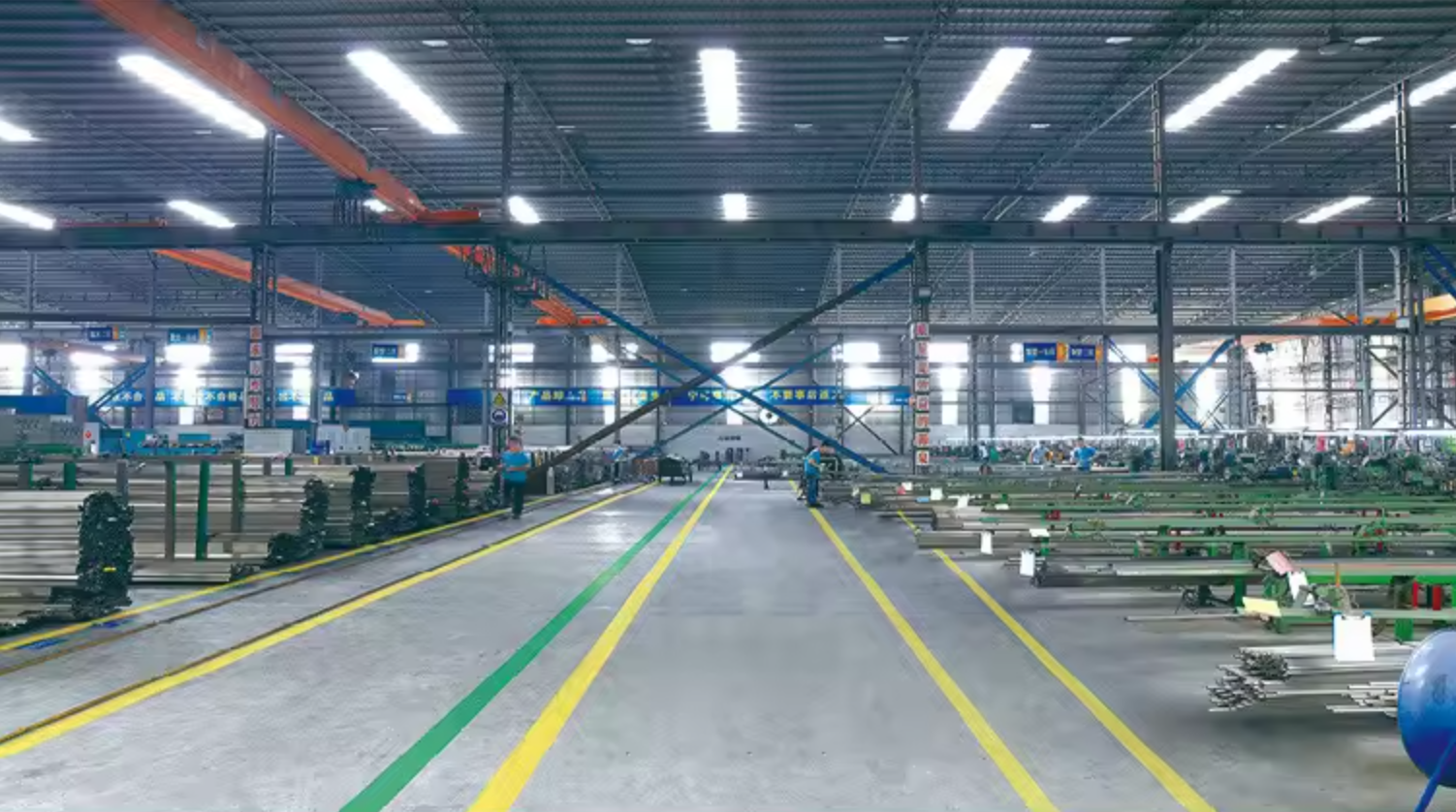
At Sanon, every product follows strict quality control during cutting, welding, polishing, and packing, ensuring compliance with ASTM International standards. Their facility spans 20,000 square meters with a monthly capacity of 5,000 tons, enabling consistent process control.
Why Do Technical Parameters and Production Quality Matter?
For buyers of stainless steel pipes used in architectural, industrial, or decorative applications, ignoring these factors leads to:
- Safety hazards: A pipe with low tensile strength may fail under load in a balustrade system.
- High maintenance costs: Poor surface finish accelerates corrosion.
- Installation delays: Dimensional mismatches require rework.
- Brand reputation damage: Inferior products reflect poorly on the end user's project.
Therefore, procurement teams must evaluate both the specifications on paper and the manufacturing capability of the supplier.
Step-by-Step: How to Evaluate Stainless Steel Pipe Quality
- Define application requirements: Determine if you need a structural pipe (high tensile, thick wall) or a decorative pipe (smooth finish, tight OD tolerance). For instance, stainless steel square pipe is often used for handrails, while stainless steel slotted pipe is common in glass railing systems.
- Review material certificates: Request mill test certificates confirming grade (304/316) and chemical composition. Check if the supplier has ISO9001 and ISO14001 certifications, which indicate quality management systems.
- Inspect surface finish: Use a profilometer to measure roughness (Ra). A mirror finish for decorative pipes should be ≤0.2μm.
- Verify dimensions: Measure OD and WT at multiple points. Acceptable tolerances are typically ±0.1mm for OD and ±0.05mm for WT in precision pipes.
- Assess production capability: Visit the factory or request process documentation. Look for automated welding, in-line eddy current testing, and regular calibration of gauges. Sanon's monthly output of 5,000 tons and adherence to ASTM standards demonstrate robust capability.
Real-World Use Cases
Case 1: Architectural Handrail System
A contractor required stainless steel round pipes and railing flanges for a commercial building. They needed 304 grade, 48.3mm OD, 2mm wall thickness, and a mirror polish. The supplier could not guarantee tight OD tolerance, causing gap issues with the flanges. Switching to Sanon—who uses CNC-controlled polishing and strict QC—eliminated the problem.
Case 2: Glass Balustrade Installation
For a glass railing project, stainless steel slotted pipes and glass clamps were required. The pipe slots had to align precisely with the clamp holes. Poor production led to misalignment; Sanon's precision slotted pipe (with <1mm slot tolerance) ensured smooth assembly.
Case 3: Decorative Color Pipe
An interior design firm specified stainless steel color pipe for a luxury lobby. The color coating required a defect-free base surface. Sanon's embossed and colour pipes undergo multiple polishing stages to achieve the required finish before coating.
Frequently Asked Questions (FAQ)
What is the difference between 304 and 316 stainless steel pipe?
304 offers good general corrosion resistance, while 316 contains molybdenum for enhanced resistance to chlorides and acids. 316 is preferred for coastal environments or chemical processing.
How do I choose between cold drawn and cold rolled pipe?
Cold drawn pipes have tighter dimensional tolerances and higher strength, ideal for precision components. Cold rolled pipes are cost-effective for standard applications.
What certifications should a quality stainless steel pipe supplier have?
Look for ISO9001:2015 (quality management), ISO14001 (environmental management), and ISO45001 (occupational health and safety). Additionally, product-specific certifications like CE marking indicate compliance with EU standards. Sanon holds all these certifications.
How does wall thickness affect pipe performance?
Thicker walls increase load capacity and durability but reduce flow area. For structural handrails, a minimum wall thickness of 1.5mm is common; for pressure pipes, schedule ratings (e.g., Sch 40, Sch 80) apply.
Can I get custom pipe profiles (oval, square, slotted)?
Yes. Many suppliers, like Sanon, offer custom shapes including stainless steel oval pipe, stainless steel square pipe, and stainless steel slotted pipe. Custom orders require detailed specifications and MOQ discussions.
Conclusion
Technical parameters and production processes are inseparable factors that define the quality, safety, and longevity of stainless steel pipes. By understanding the meaning of each specification and how manufacturing steps influence it, buyers can make informed decisions, reduce procurement risks, and build lasting partnerships with capable suppliers. Companies like Sanon exemplify how rigorous process control, certification, and capacity translate into consistent, high-quality products. For your next project, use the framework provided here to evaluate potential partners and ensure your stainless steel pipe selection meets both specification and performance expectations.
Contact Sanon for expert guidance and customized solutions: Phone/WhatsApp: +86 135 3668 1776, Email: sales@sanoninox.com. Visit www.sanoninox.com.
Have Questions or Need More Details?
Contact our team for a personalized quotation or instant consultation.
Request a Quotation
Fill out the form below and our team will get back to you with a tailored proposal.
WhatsApp Direct Chat
Prefer to chat in real-time? Message us on WhatsApp for instant assistance & quick answers.
- Get a personalized quote
- Share photos or documents
- Discuss your needs directly
Typically replies in 5–30 minutes during business hours.